

Embu, Kenya
Kamavindi Gesha comes from Peter Mbature and his family at Kamavindi Estate in Embu, on the southeastern slopes of Mount Kenya. The farm was established in 1958 by Peter's grandfather, John Njiru Mbature, who planted the first 100 coffee trees at a time when native Kenyan farmers were restricted to that number. From those first trees, Kamavindi has grown to around 10,000 trees and is now run by the third generation of the family, including Peter and his sisters.
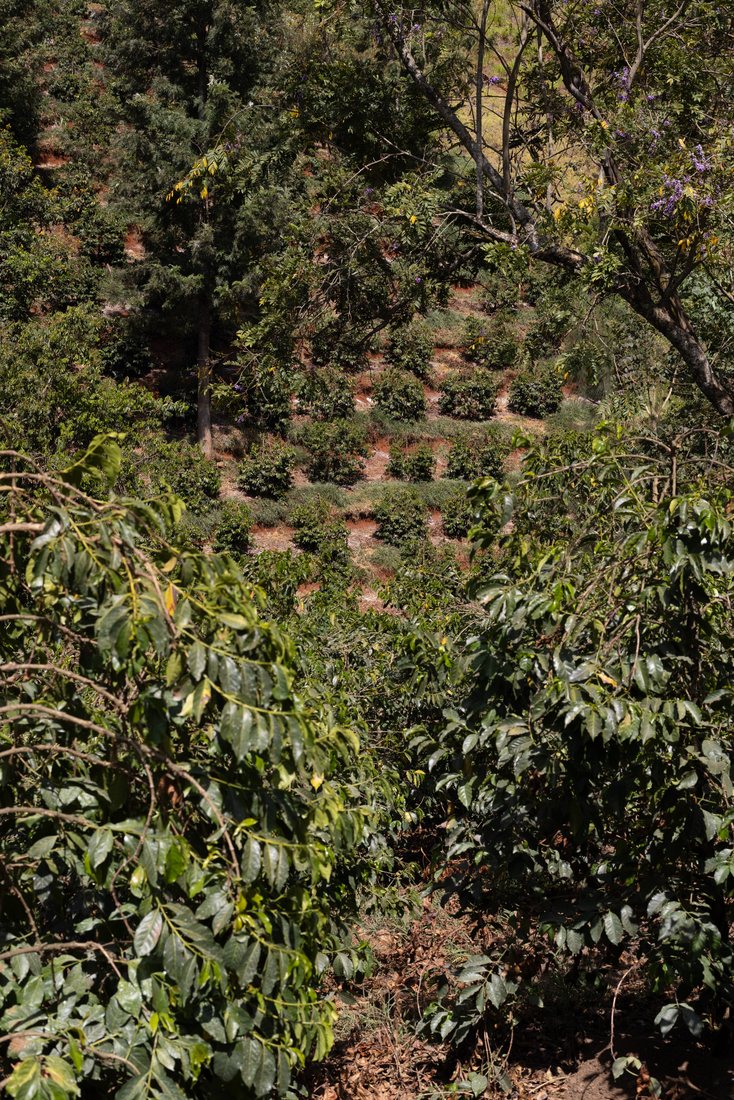
On the farm
We have spent a lot of time with Peter at Kamavindi, walking through the different plots, tasting separations and talking through what he is trying to change on the farm. What makes the Gesha particularly exciting is that it is still developing in front of us. This is not an established block producing the same coffee year after year. Peter is still learning which trees perform best, which ones hold their resistance, how much nutrition they need and how the variety behaves when propagated in different ways.
The Gesha is still a very small part of Kamavindi, but Peter is actively expanding it. In one plot, around 1,000 additional stems are already being grafted over to Gesha, and the work is continuing. His aim is not simply to plant more of a famous variety. He is trying to understand whether Gesha can become something stable and productive at Kamavindi, rather than remaining a tiny experimental planting.
The trees
That means paying close attention to the trees themselves. Peter has identified several different expressions within the Gesha planting, including green tip, bronze tip and compact forms. He has been separating individual trees, tasting them independently and selecting material based on cup quality, production and disease resistance.
One of the most interesting examples came from a compact tree they had been treating as Gesha. Peter sent leaf samples for genetic testing and learned that it was actually a Gesha x Catimor cross. Instead of seeing that as a disappointment, he became interested in what the tree could offer: strong production, good resistance to coffee berry disease and leaf rust, and a cup he still found very good. It is a small example of the way he works, observing what is actually happening on the farm rather than forcing the plants into a fixed idea of what they should be.
The pure Gesha also requires more attention. Peter explains that its rooting system is relatively weak, so he feeds these trees much more heavily than some of the other varieties at Kamavindi. In one comparison, where another tree might receive around 20 kg of compost, the Gesha receives closer to 40 kg.
That extra work is beginning to change his expectations of the variety. Peter initially associated Gesha with very low production, but as nutrition has improved, he is seeing trees carry substantially more cherry. He now believes well managed Gesha at Kamavindi can produce far more than the one or two kilos per tree he had once expected, even if it still does not reach the productivity of SL28.
Disease resistance is another part of the selection. Peter showed us green tip Gesha trees that were holding up well against leaf rust beside other plants showing clear damage. Where he sees a weaker tree, he is increasingly grafting with material from Gesha plants that have shown better resistance. His thinking is long term: leaf rust may not be the biggest problem at Kamavindi today, but he wants the farm to be prepared if that changes.
The lot
ProducerPeter Mbature / Mbature family
FarmKamavindi Estate
RegionEmbu, Kenya
Elevation1,680 masl
VarietyGesha
ProcessWashed
HarvestDecember 2025
DryingRaised beds under shade nets
For this washed lot, ripe cherries are picked by hand, carefully sorted and floated before pulping. The coffee is fermented in two stages, washed, density sorted and then dried slowly on raised beds under shade nets. It is a very traditional structure for Kenyan washed coffee, and that restraint is important here. The processing gives the Gesha space to show itself without making fermentation the dominant flavor.
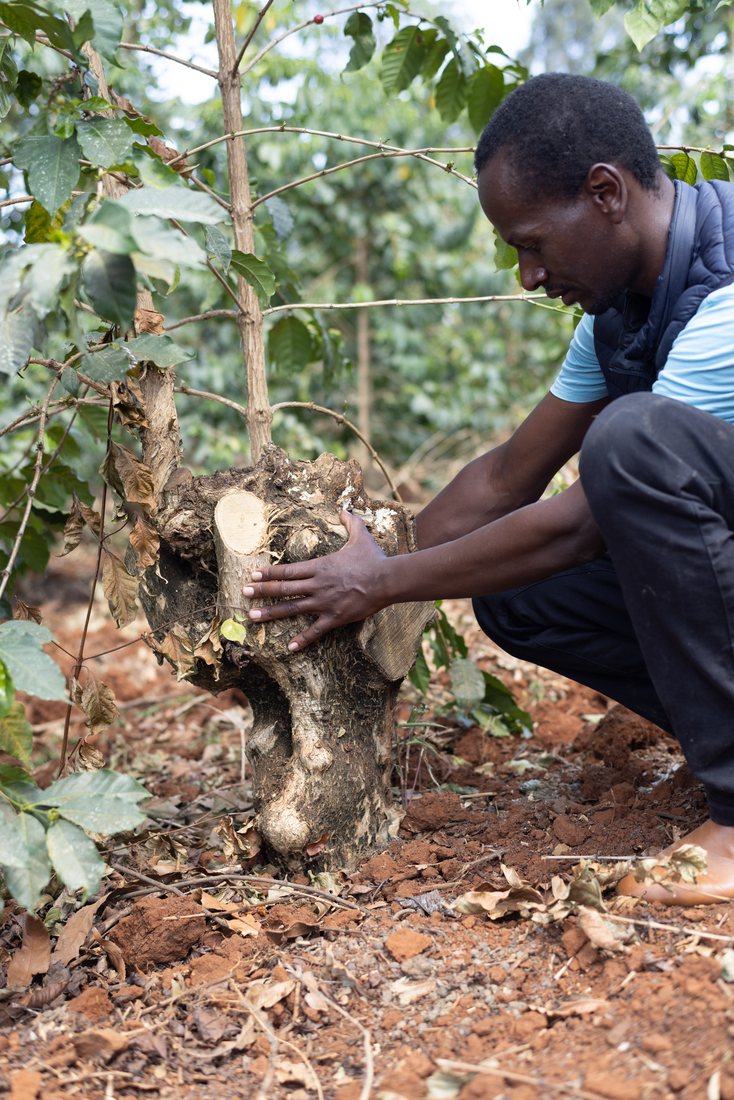
The original planting
What we find most compelling about Kamavindi is that all of this work sits beside something much older. During our visit, Peter showed us one of the original stems planted by his grandfather in 1958. Through repeated pruning and regeneration, that same plant is still productive today, producing new young shoots from a stem that has been on the farm for more than sixty years.
Peter never met his grandfather. Standing beside that tree, he told us that it feels good to be able to make a living from an investment made before he was born. That connection between generations is visible across Kamavindi: original SL trees from the 1950s, newer Kenyan varieties grafted onto older root systems, and now Gesha being selected and propagated for whatever the next generation of the farm might look like.
For us, this is what makes the Kamavindi Gesha worth telling. There is very little of it, but scarcity is only part of the story. What interests us more is that we are able to taste this coffee while Peter is still figuring it out: selecting trees, grafting new material, testing genetics, adjusting nutrition and deciding what deserves to become a larger part of the farm.
Leave a comment